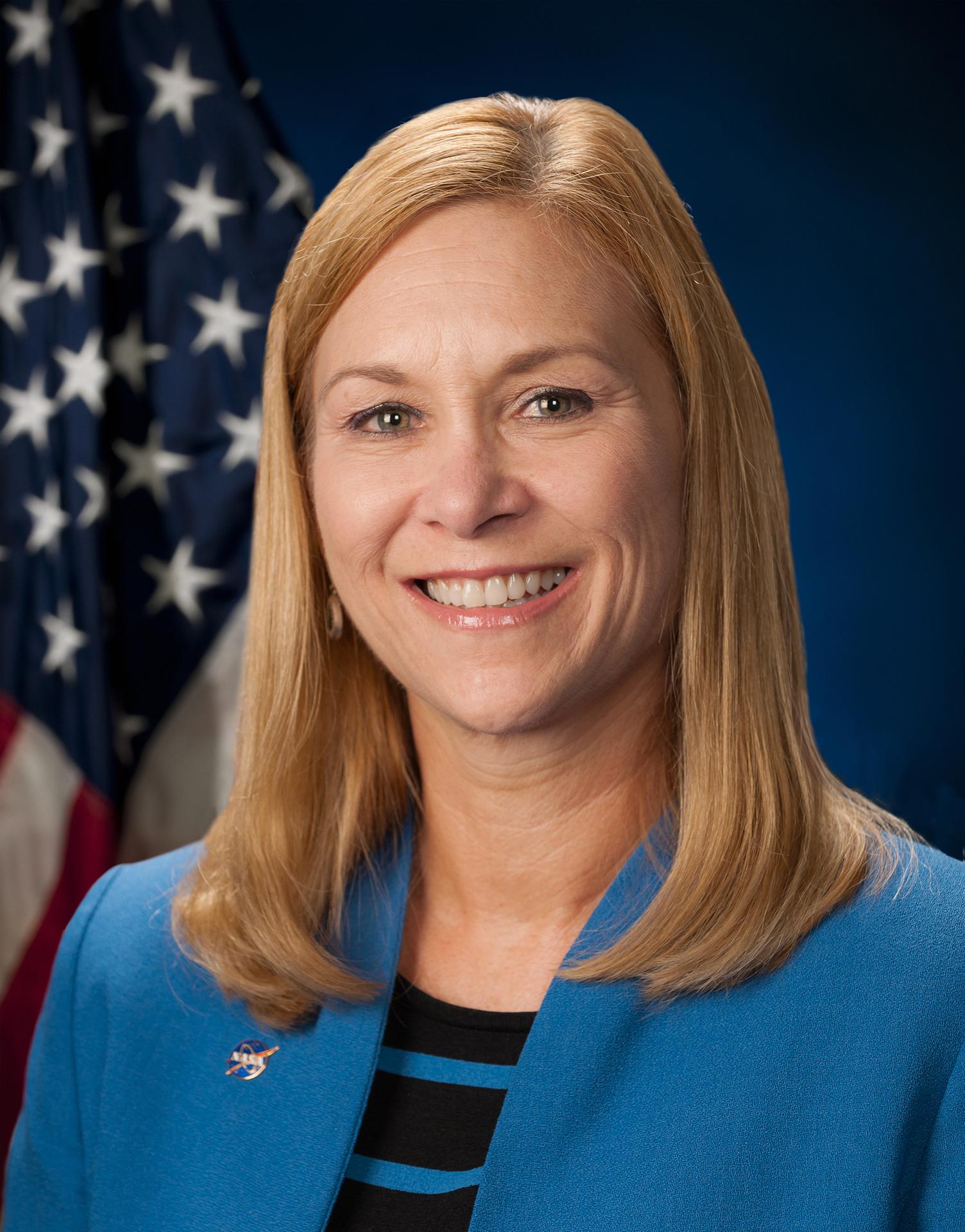
Portrait of Janet Petro, center director for NASA’s Kennedy Space Center in Florida.
Credit: NASA
NASA announced Friday Janet Petro, center director for the agency's Kennedy Space Center in Florida, is retiring.
Prior to joining NASA, Petro worked in a variety of military and industry positions, ultimately beginning her career at the agency in 2007 and working her way up to center director, as well as serving as acting administrator from January to July 2025.
"From the outset of her distinguished tenure at NASA, Janet has served as a profoundly influential leader, guiding both the agency and our Kennedy Space Center through some of the most significant transitions in our shared history, including playing a central role in reshaping NASA Kennedy into the nation's premier multiuser spaceport," said NASA Administrator Jared Isaacman. "As NASA has been charged, once again, with accomplishing the near impossible, I'm grateful for Janet for always embracing the challenge of discovering what could be and for pushing the boundaries to deliver the missions that enable NASA to lead the way into a new era of space."
As NASA Kennedy's 11th director, Petro manages a team of civil service and contractor employees, determining and implementing center policy and managing and executing the spaceport's missions and agency program responsibilities. Previously, Petro served as acting director and NASA Kennedy's deputy director. During her time as deputy director, she helped the center transition into a multi-user spaceport, leading cross-agency initiatives with the FAA (Federal Aviation Administration) and U.S. Air Force to streamline government processes and support commercial space operations to increase government efficiency and limit redundancy.
Petro also has served numerous roles at Kennedy and NASA Headquarters in Washington, including as the program executive on an agencywide initiative to restructure mission support functions, helping NASA become more efficient and effective in its work.
Outside of the agency, Petro has served in various management positions for Science Applications International Corporation, or SAIC, and McDonnell Douglas Aerospace Corporation, interfacing with NASA, U.S. military, and commercial entities on numerous aerospace and military programs.
Petro began her professional career as a commissioned officer in the U.S. Army after graduating in 1981 from the U.S. Military Academy at West Point, New York, with a bachelor of science degree in engineering. She was in the second class of West Point graduates to include women. Petro also holds a master of science degree in business administration from Boston University's Metropolitan College.
Petro is the recipient of numerous service and performance awards, including a President's Distinguished executive award, and has received the astronaut-selected Silver Snoopy award for outstanding performance, contributing to flight safety and mission success. In 2018, Petro was selected by Florida Governor Rick Scott for induction in the Florida Women's Hall of Fame, and she helped lead the senior management team awarded the 2019 Samuel J. Heyman Service to America Sammies Management Excellence Medal. She received the 2022 Dr. Kurt H. Debus Award by the National Space Club Florida Committee for her contributions to America's aerospace efforts within the state of Florida.
Effective Friday, Kelvin Manning now is stepping into the role of acting center director, bringing more than 32 years of leadership and technical expertise. He has previously served as deputy center director.
For more about NASA's missions, visit:
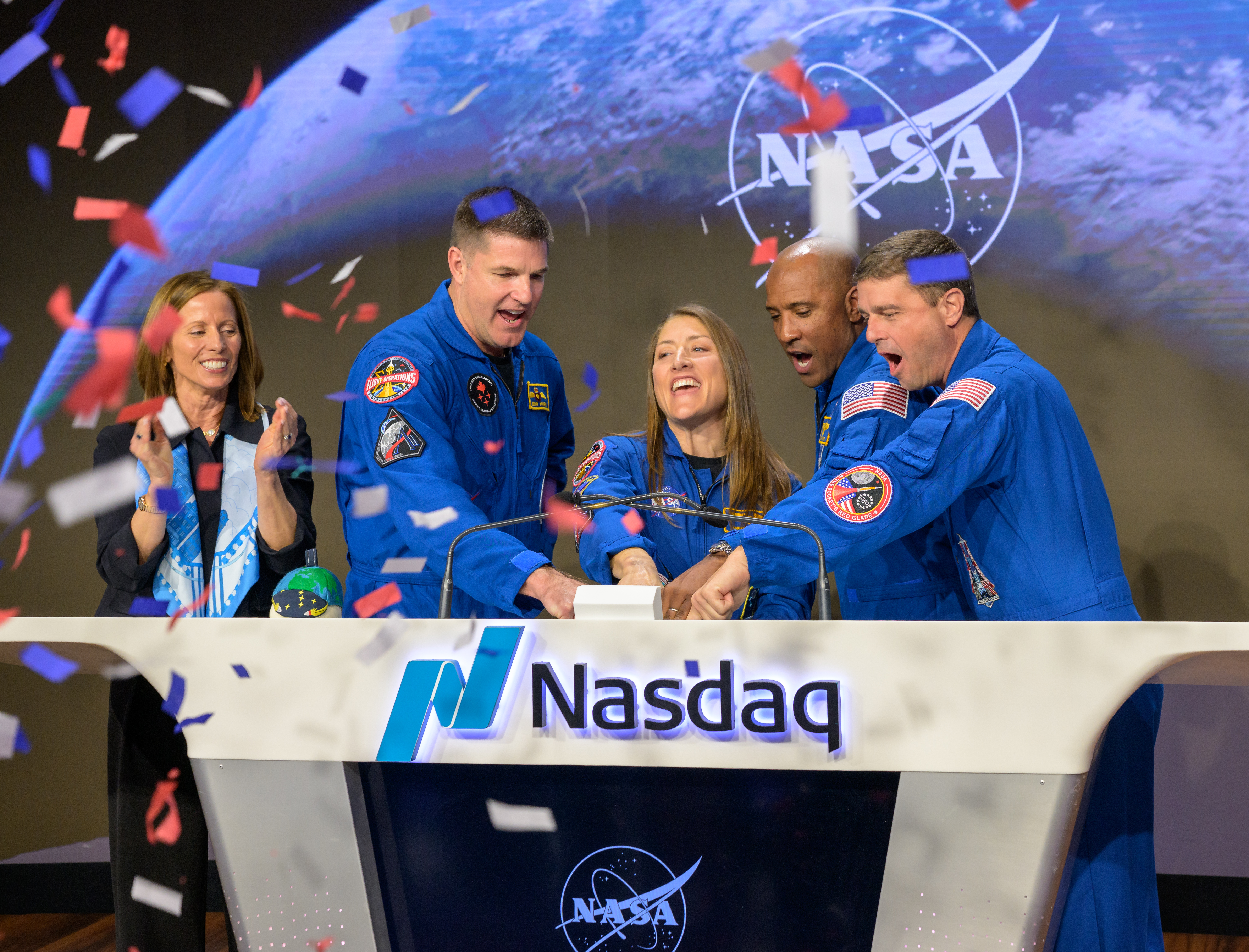
Nasdaq Chair and Chief Executive Officer Adena T. Friedman, left, and NASA's
Artemis II
crewmembers CSA (Canadian Space Agency) astronaut Jeremy Hansen, and NASA astronauts Christina Koch, Victor Glover, and Reid Wiseman, right, ring the closing bell of the Nasdaq market session, Thursday, April 30, 2026.
NASA's Artemis II mission took Wiseman, Glover, Koch, and Hansen on a nearly 10-day journey around the Moon and back to Earth earlier in April 2026.
Image credit: NASA/Bill Ingalls
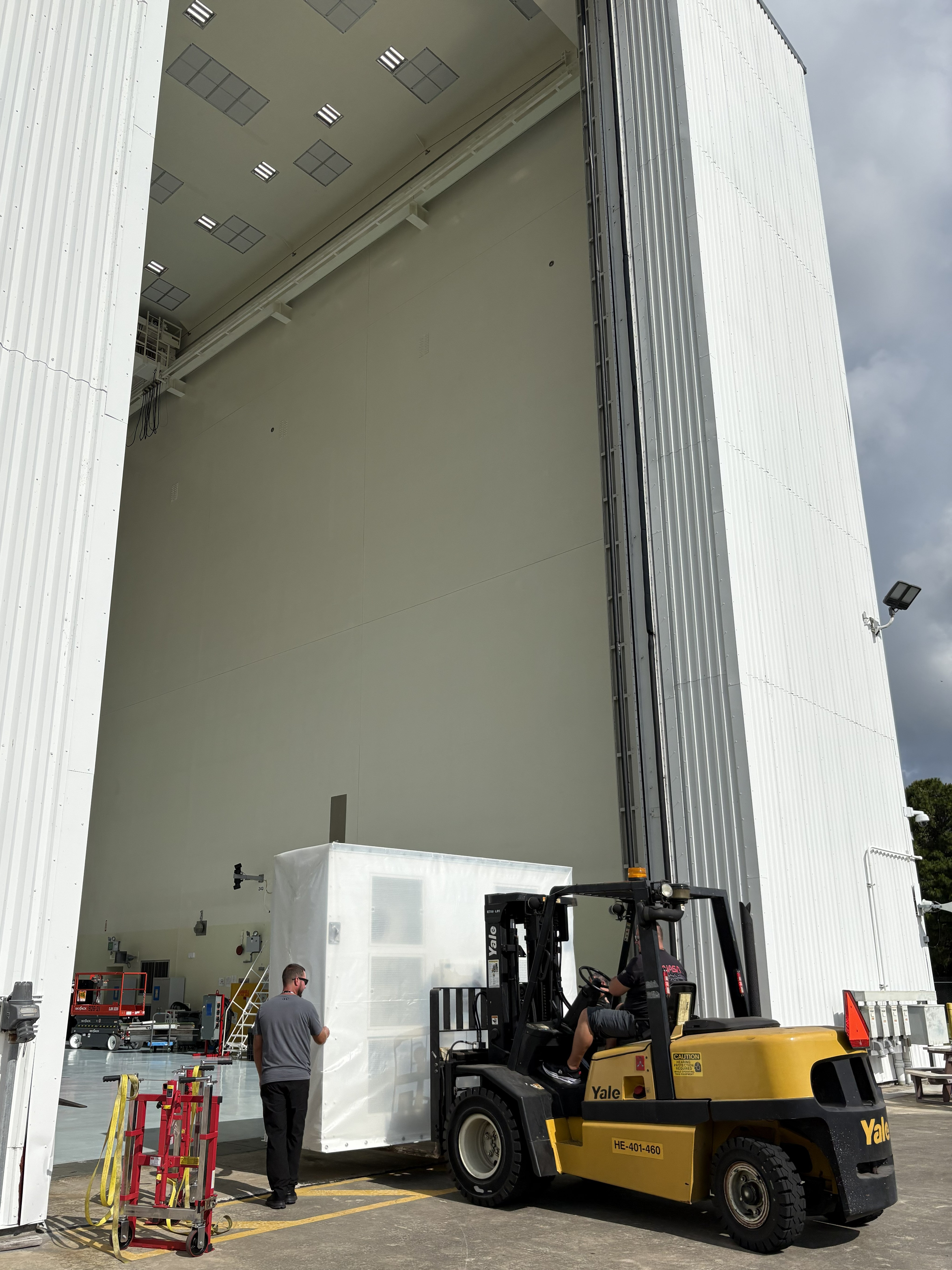
Technicians at NASA's Payload Hazardous Servicing Facility (PHSF) at the agency's Kennedy Space Center in Florida offloaded eight high-efficiency particulate air (HEPA) wall modules and other ground support equipment on April 27. The equipment will support launch processing of the agency's Nancy Grace Roman Space Telescope.
Each 1,800-pound module enhances the
PHSF's
clean room systems, helping meet the telescope's stringent cleanliness requirements during its time in the facility, where the observatory will undergo key tasks such as spacecraft fueling prior to liftoff.
Roman will observe the universe in infrared light using its Wide Field Instrument and a Coronagraph Instrument technology demonstration. Its wide field of view will produce panoramic images that help astronomers investigate some of the
greatest mysteries in the cosmos
, including why the universe's expansion appears to be accelerating.
By using multiple complementary techniques,
Roman
will chart how the universe has evolved over cosmic time and provide new insights into the nature of dark energy. Roman also will advance the study of exoplanets and map the structure and distribution of normal matter and dark matter across space and time.
Teams are targeting launch
as soon as early September
aboard a SpaceX Falcon Heavy rocket from Launch Complex 39A at NASA Kennedy.
Photo credit: NASA/Leejay Lockhart
NASA's STORIE Mission to Tell Tale of Earth's Ring Current
Earth's magnetic field is like a powerful trap. It lures electrically charged particles in space, near our planet, and snares them in an invisible, doughnut-shaped pen around Earth known as the ring current.
This captive swarm of charged particles plays an important role in how Earth reacts to changing conditions in space, called
space weather
, which can affect the technology we rely on, such as satellites and power grids. Yet there is still a lot we do not know about the ring current.
NASA is preparing to launch a mission designed to provide a unique, inside-out view of the ring current. Called STORIE (Storm Time O+ Ring current Imaging Evolution), it is scheduled to launch in May aboard the 34th SpaceX commercial resupply services mission to the International Space Station for NASA. The mission is flying as part of the Space Test Program - Houston 11 (STP-H11) payload, a partnership between the U.S. Space Force and NASA. Once it is robotically installed on the exterior of the space station (expected a few days after its arrival), STORIE will look outward at the ring current, helping scientists answer longstanding questions about how it grows and shrinks and what kind of particles it's made of.
The ring current is an invisible, doughnut-shaped swarm of charged particles around Earth (shown here in blue). It overlaps the outer of two Van Allen radiation belts (which are shown in green), but the ring current contains lower-energy particles than the radiation belts. In the ring current, positively charged particles and negatively charged particles flow in opposite directions, creating electrical currents. Changes in the ring current influence how our planet responds to solar storms and can have impacts on our technology.
NASA/Mary Pat Hrybyk-Keith/Kristen Perrin
"These particles have important space weather impacts," said Alex Glocer, STORIE's principal investigator at NASA's Goddard Space Flight Center in Greenbelt, Maryland, where the instrument was designed and constructed. "We want to understand how that trapped population is built up, and where it comes from."
These details are especially important during solar storms, when outbursts from the Sun can lead to magnetic disturbances at Earth. Similar to Earth's
Van Allen radiation belts
but filled with lower-energy particles, the ring current tends to fluctuate in size, shape, and intensity more dramatically than the radiation belts do during solar storms. Plus, in the ring current, positively charged particles and negatively charged particles flow in opposite directions, creating electrical currents. So, changes there can lead to magnetic fluctuations and induced currents on the ground, potentially affecting pipelines and power lines. The ring current can also contribute to charge buildup on the surface of Earth-orbiting satellites, which can spark spacecraft glitches. Additionally, when energy ramps up in the ring current, some of that energy gets transferred to the upper atmosphere, making it heat up, puff out, and create more drag on satellites, which can cause the spacecraft to deorbit sooner than expected.
This simulation shows fluctuations in the ring current (left) and the outer Van Allen radiation belt (right) during a solar storm. The ring current and outer radiation belt overlap in space, but the ring current fluctuates more dynamically than the radiation belt does, while the radiation belt grows more slowly in intensity.
NASA/Austin Brenner
However, it's difficult to study the ring current directly because the particles within it are invisible. "You can't just image them with a camera," Glocer explained.
Instead, STORIE will scan for the glow of energetic neutral atoms, or ENAs, that are formed when charged particles trapped in the ring current manage to escape. The particles earn their freedom by stealing an electron from Earth's outer atmosphere, known as the exosphere, and become neutral.
"Once those charged particles become neutral, they no longer feel the effects of Earth's magnetic field, and they are no longer trapped," Glocer said. "They can just fly off in any direction."
By measuring the speed and direction of the ENAs, STORIE could help answer longstanding questions about the origins of particles in the ring current - whether they are supplied by a stream of particles flowing out from the Sun, known as the solar wind, or from Earth.
NASA's STORIE (Storm Time O+ Ring current Imaging Evolution) instrument is shown here installed on the Space Test Program - Houston 11 (STP-H11) payload, a partnership between the U.S. Space Force and NASA. It is covered in blanketing material to protect STORIE from the space environment. After launch, the STP-H11 payload and STORIE will be installed on the outside of the International Space Station's Columbus module.
U.S. Space Force
The STORIE team designed the instrument to pay special attention to positively charged oxygen atoms (O+) because, according to Glocer, "When you see oxygen, that comes from the atmosphere. You get very little of that from the solar wind." If STORIE finds a lot of oxygen atoms, scientists will know the ring current is largely supplied by Earth's atmosphere, rather than the solar wind.
Glocer and other scientists also want to find out whether the ring current's population of charged particles build up in quick bursts or slowly and gradually. "Is it like filling a lake with the steady flow of a waterfall or a bunch of raindrops?" Glocer said.
NASA is launching a new experiment, called STORIE (Storm Time O+ Ring current Imaging Evolution), to track charged particles in a "space doughnut" that encircles our planet.
NASA's Goddard Space Flight Center
Previous NASA missions - such as
IMAGE
(Imager for Magnetopause-to-Aurora Global Exploration) and
TWINS
(Two Wide-angle Imaging Neutral-atom Spectrometers) - have looked at ring current ENAs before using a top-down view, which allowed them to see the whole ring current at once. However, from that perspective, ultraviolet light reflected by Earth - in the center of the ring - can interfere with the ENA observations, and the viewing geometry makes it hard to see trapped particles in the ring current near Earth's equator.
"From STORIE's inside-out perspective, you have Earth behind you, and you can see this trapped population near the equator that was hard for other missions to observe," Glocer said.
After being installed on the International Space Station, NASA's STORIE mission will scan outward, away from Earth, to image energetic neutral atoms (ENAs) from Earth's ring current. It will view one slice of the ring current at a time, but as it orbits Earth, STORIE will build up a complete view of this invisible, doughnut-shaped band of particles. In this animation, the curved orange lines represent field lines in Earth's magnetic field, and the moving wedge of green rays represents STORIE's field of view as the space station orbits the planet.
NASA/Gonzalo Cucho-Padin
Some sounding rocket experiments have gotten brief, inside-out views of the ring current in the past, but they only had a few minutes to observe and could only see a portion of the ring current during each flight. The view from STORIE will reveal one slice of the ring current at a time, but as the space station orbits Earth, STORIE will build up a complete picture of the ring current roughly every 90 minutes.
Over its six-month mission, STORIE will monitor how the ring current evolves over time and allow scientists to compare its behavior during solar storms versus when the Sun is quiet. Insights from STORIE will help us better understand how Earth responds to solar storms, improve space weather predictions, and help mitigate the effects of space weather on the technology humanity depends on.
By Vanessa Thomas
NASA's Goddard Space Flight Center, Greenbelt, Md.
Space Out This Summer with Variety of NASA STEM Activities
Summer is "Go" for launch, and NASA has a universe of ways to help you to jump in, explore, and create! Whether you prefer to spend this season fueling your creativity, going outdoors into nature, or daydreaming about your future, NASA offers ways to take your interests to the next level.
Here are some opportunities to level up your skills with NASA STEM this summer.
Rise to Stardance Challenge
From Monday, June 1, through Sept. 30, students ages 13 to 18 are invited to flex their creativity in the online Stardance Challenge, a partnership between NASA and the education non-profit Hack Club. Whether you’re into space, coding, hardware, or just love building cool things, this is your chance to work with real NASA mission data from programs like Artemis, the James Webb Space Telescope, and more.
Participants can create anything from code and apps to electronics, circuit boards, models, and simulations. Hack Club will offer peer and expert reviews, prizes, and plenty of opportunities to show off your work. Meanwhile, NASA will provide access to publicly available datasets, mission materials, multimedia, and virtual sessions with subject matter experts who can share insights on space science, engineering, and careers. Ready to start brainstorming? Visit the
Hack Club: Stardance Challenge
website to explore project options, check out prizes, and RSVP to get a reminder when the challenge opens
NASA Astronaut Megan McArthur is conducting a technology demonstration with Astrobee flying robots.
Credit: NASA
Go Behind Scenes of NASA Careers
Think NASA is only for astronauts, scientists, and tech experts? Think again. It takes a wide range of professionals and specialists to bring the nation's aerospace goals to life. Summer is the perfect time to discover how your skills and interests could make a difference at NASA.
Connect directly with NASA experts through online events designed to spark your curiosity and help you explore real STEM career paths. These virtual sessions provide a behind‑the‑scenes look at NASA's workforce, plus the chance to ask questions.
Looking for more? Check out the
Next Gen STEM for Careers
web page for videos, articles, and more ways to learn about the variety of jobs at NASA.
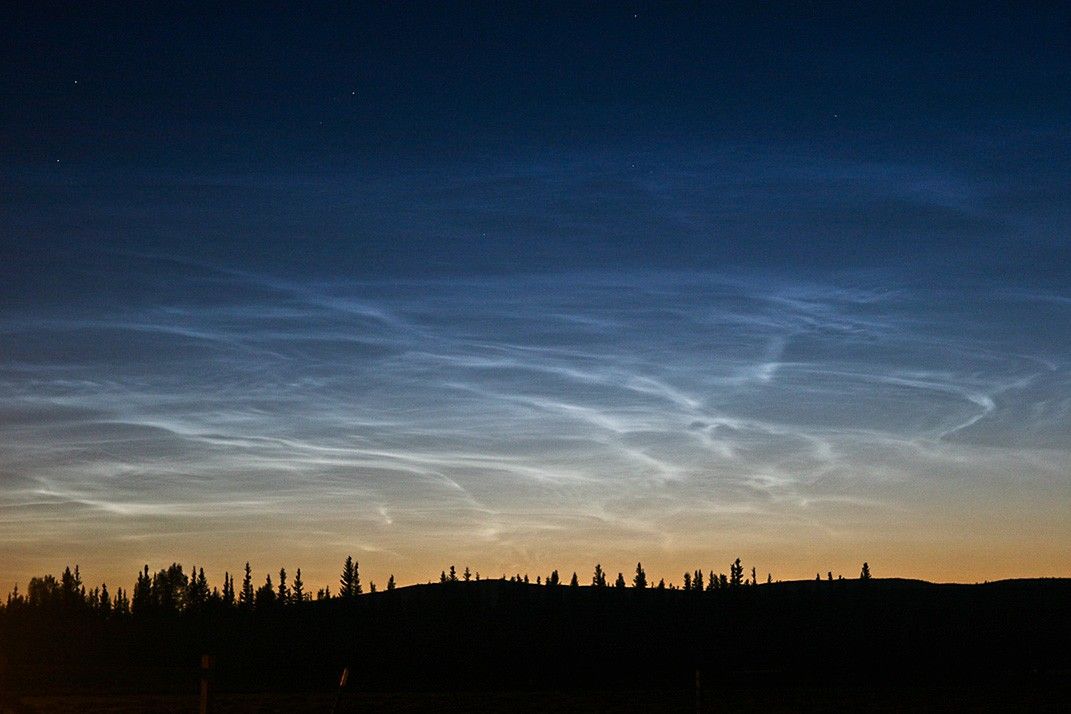
Noctilucent clouds seen from Fairbanks, Alaska.
Credit: Patrick Cobb – Photovoltaic designer, photographer
Dive into NASA Research Through Citizen Science
NASA invites people of all ages and backgrounds to do NASA science as a part of real science projects that rely on volunteers. Citizen Science is a great way to make new friends, meet some scientists, and help NASA solve mysteries of the universe this summer - using just a phone or computer. You can join from anywhere, participate on your own schedule, and dive right into real research using actual mission data. Here are two examples:
Through
Space Cloud Watch
, you can help NASA study noctilucent clouds. Noctilucent means "night-shining," and that's exactly what they do! During summer twilight at high latitudes, these clouds catch sunlight and appear to glow even in a darkened sky. Take a photo and submit a report to help scientists track how these rare clouds are changing.
Take your cloud‑watching to another planet with
Cloudspotting on Mars
, where you review real NASA images to identify clouds above the Red Planet and help scientists understand Martian weather.
Curious about what other projects you might enjoy? See all current
Citizen Science opportunities
available through NASA's Science Mission Directorate.
No matter how you spend your summer - building projects like the Hack Club's Stardance Challenge, jumping into real NASA research through citizen science, or exploring possible NASA career paths - there's a launch pad waiting for you. And remember, NASA's
STEM Resources
website is available year-round to serve as your one-stop hub for hands-on activities, videos, articles, and more to spark curiosity and fuel big ideas.
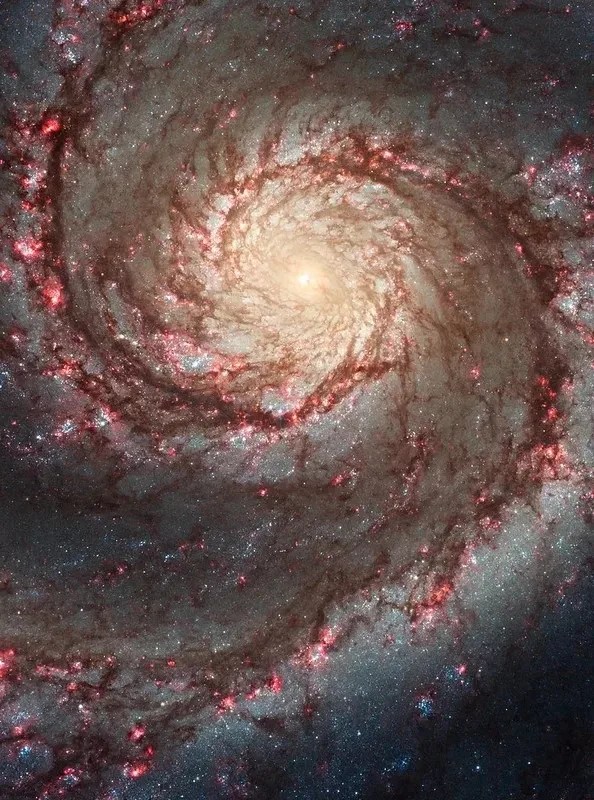
This NASA Hubble Space Telescope image features the glittering spiral galaxy NGC 3137, located 53 million light-years away in the constellation Antlia (the Air Pump).
ESA/Hubble & NASA, D. Thilker and the PHANGS-HST Team
In this new picture from NASA's
Hubble Space Telescope
, a spiral galaxy glittering with star clusters is the center of attention. NGC 3137 is located 53 million light-years away in the constellation Antlia (the Air Pump). As a nearby spiral galaxy, this target offers astronomers an excellent opportunity to study the cycle of stellar birth and death, as well as giving researchers a glimpse of a galactic system similar to our own.
NGC 3137 is of particular interest to astronomers because it travels through space with a group of galaxies that is thought to be similar to the Local Group, the galaxy group that contains our Milky Way. Similar to the Local Group, the NGC 3175 group contains two large spiral galaxies: NGC 3137 and NGC 3175, which
Hubble has also observed
. In the Local Group, the largest members are the Milky Way galaxy and Andromeda, another spiral galaxy. In addition to two large spiral galaxies, both groups also contain a number of smaller dwarf galaxies, although it's not yet known how many of these tiny companions the NGC 3175 group has; researchers have found more than 500 dwarf galaxy candidates. By studying this nearby galaxy group, astronomers can learn about the dynamics of our own galactic home.
NGC 3137 is revealed in fantastic detail by Hubble. This image is crafted from observations in six different color bands, creating a view that highlights several facets of this beautiful spiral. The galaxy's center, which is encircled by a network of fine, dusty clouds, hosts a black hole estimated to be 60 million times more massive than the Sun. NGC 3137 is highly inclined from our point of view, giving a unique perspective on its loose, feathery spiral structure. A couple of photobombing Milky Way stars and a smattering of far more distant background galaxies complete the image.
As stunning as each of these features may be, it's the galaxy's brilliant star clusters that steal the show. The galaxy is peppered with dense clusters of bright blue stars and glowing red gas clouds, which signal the presence of hot, young stars still encased in their birth nebulae.
Unsurprisingly, these star clusters are exactly what has drawn Hubble's keen eye. Researchers are using Hubble to carry out an observing program (#
17502
; PI: D. Thilker) focusing on star clusters in 55 nearby galaxies. The data collected will help astronomers identify star clusters and the glowing nebulae that surround them, providing a way to measure the ages of stars in galaxies like NGC 3137. These observations give an in-depth view of stellar life in spiral galaxies, from the young stars still in the process of forming to the ancient stellar populations that grew up in the early years of their galactic hosts.
The PHANGS (Physics at High Angular Resolution in Nearby Galaxies)-HST program for which these observations were taken is part of a larger effort by some of the most powerful observatories on (and around) Earth. Hubble contributes greatly to this massive undertaking, which combines Hubble data with observations from the NASA/ESA/CSA
James Webb Space Telescope
and the
Atacama Large Millimeter/submillimeter Array
(ALMA). Together, Hubble's powerful optical and ultraviolet capabilities, Webb's sensitive infrared eyes, and ALMA's broad network of radio dishes bring us an unmatched view of star formation in the local universe.
Text credit: ESA/Hubble
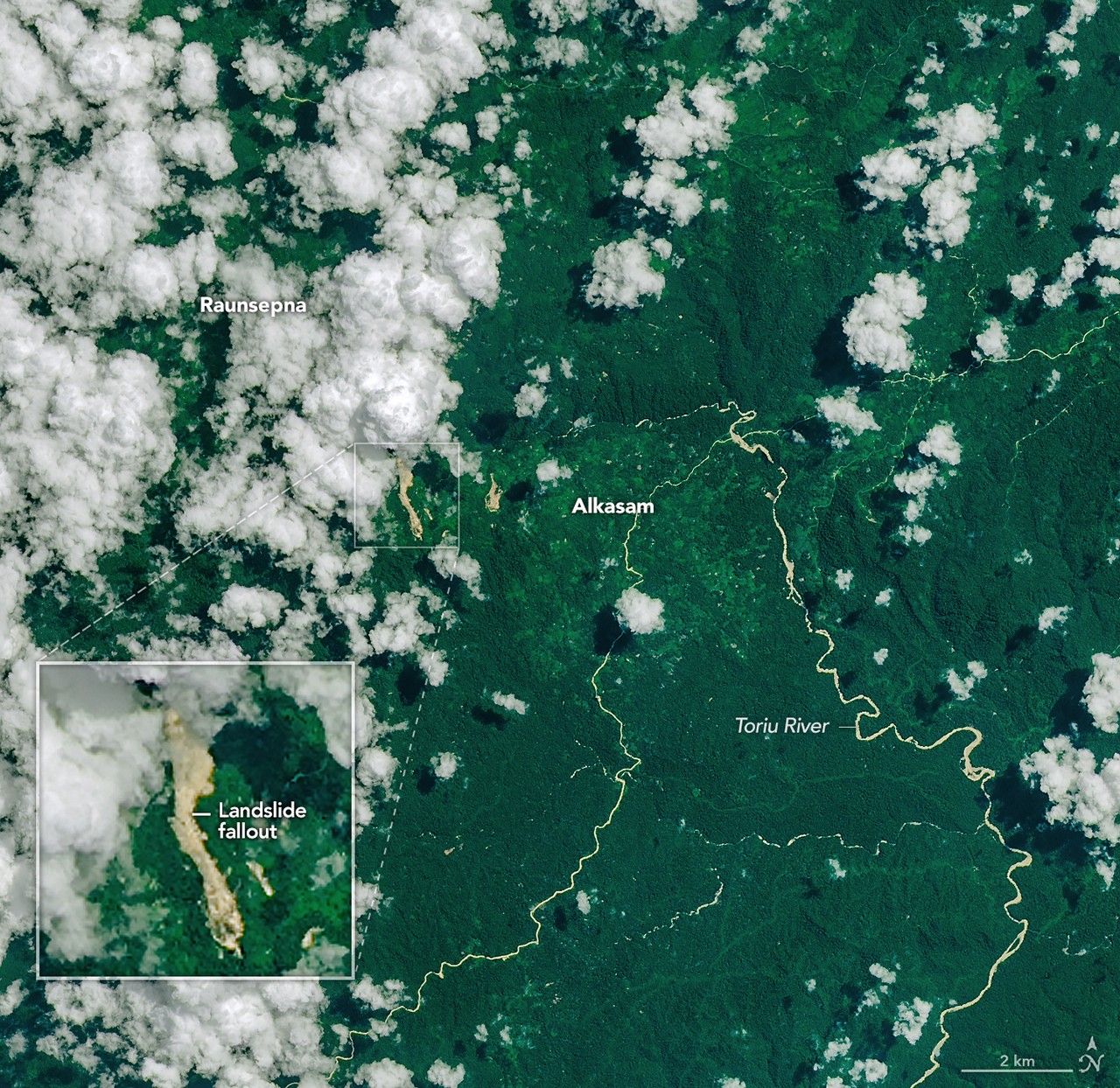
During a break in the clouds, the
OLI
(Operational Land Imager) on
Landsat 9
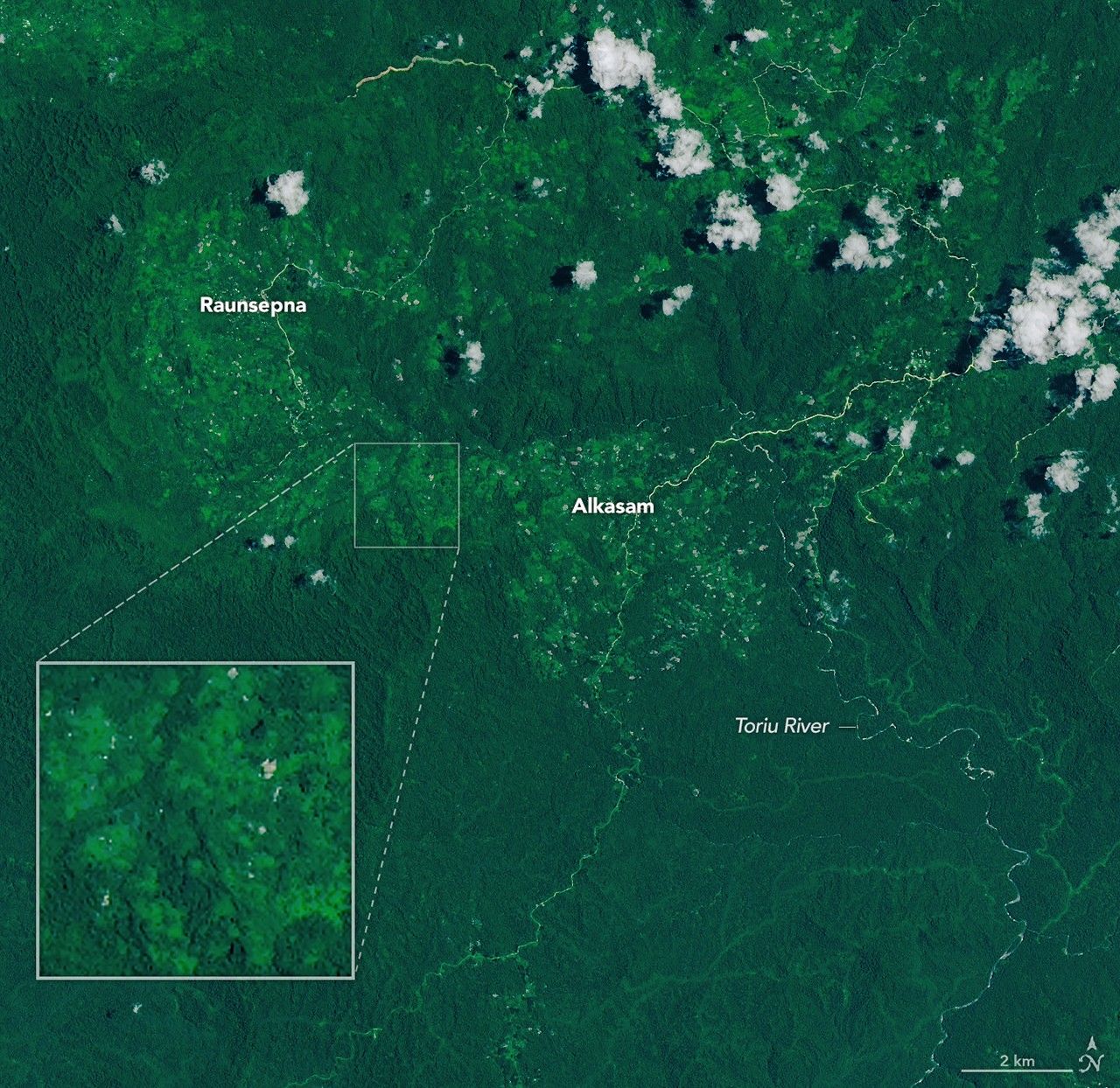
captured an image of landslide fallout in the forested Gazelle district of East New Britain on April 20, 2026 (right). A second image from Landsat 9 shows the same area on September 24, 2025 (left), before the landslides.
Since much of Papua New Guinea lies close to the equator where the
Coriolis effect
is weak, the risk of
tropical cyclones
striking the island nation is relatively low, especially in its northern areas. Nevertheless,
unusually warm
sea surface temperatures and atmospheric conditions favorable to storm formation brought powerful
Tropical Cyclone Maila
dangerously close to the islands of Bougainville, New Britain, and New Ireland in April 2026, fueling
intense rainfall
.
The heavy rains saturated steep terrain in the Gazelle district of East New Britain, triggering landslides on and around April 9 that led to several deaths, according to
news reports
. The
Landsat 9
satellite captured an image of the fresh landslide scars cutting through the dense tropical forests in the Baining Mountains on April 20, 2026. The Toriu River and other sediment-laden waterways are visible to the east of the landslides.
The landslides appear as light-brown swaths of exposed soil and debris extending north toward a nearby river valley, contrasting with the surrounding green vegetation and scattered white clouds. A second image from Landsat 9 shows the same area on September 24, 2025, before the landslides.
Maila was notable for its intensity-reaching Category 4 strength on
Australia's cyclone intensity scale
(Category 3 on the
Saffir-Simpson scale
used for U.S. hurricanes)-and also for its slow movement near Papua New Guinea. Instead of passing quickly through the region, Maila lingered, allowing rainbands to repeatedly strike East New Britain. Satellite-based
precipitation estimates
from NASA's
Global Precipitation Measurement
(GPM) mission indicate that hundreds of millimeters of rain likely fell across the region in less than a week.
NASA's
Landslide Hazard Assessment for Situational Awareness
(LHASA) model uses precipitation estimates from GPM along with slope, soil, and land cover data to identify areas where rainfall is likely to
trigger landslides
. During the height of the storm, LHASA highlighted parts of East New Britain-including the Baining Mountains-as having an
elevated risk
of slope failure.
NASA Earth Observatory images by Michala Garrison, using Landsat data from the
U.S. Geological Survey
.
Story by Adam Voiland.
Ireland will sign the Artemis Accords during a ceremony at 3 p.m. EDT Monday, May 4, at NASA Headquarters in Washington.
NASA Administrator Jared Isaacman will host Ambassador of Ireland to the United States of America Geraldine Byrne Nason; Minister for Enterprise, Tourism and Employment Peter Burke, T.D., of Ireland; and U.S. Department of State officials for the ceremony.
This event is in person only. Media interested in attending must RSVP no later than 12 p.m. on May 4 to:
hq-media@mail.nasa.gov
. NASA's
media accreditation policy
is online.
In 2020, during the first Trump Administration, the United States, led by NASA and the State Department, joined with seven other founding nations to establish the Artemis Accords, responding to the growing interest in lunar activities by both governments and private companies.
The accords introduced the first set of practical principles aimed at enhancing the safety, transparency, and coordination of civil space exploration on the Moon, Mars, and beyond.
Learn more about the Artemis Accords at:
Team members past and present from NASA's 2001 Mars Odyssey orbiter mission gathered on April 15, 2026, to celebrate 25 years since the spacecraft's launch, which took place April 7, 2001. For the occasion, the team rolled out a giant global map of Mars created using imagery from Odyssey's THEMIS (Thermal Emission Imaging System) infrared camera. The celebration took place at NASA's Jet Propulsion Laboratory in Southern California, which leads the mission.
Shooting stars before dawn, a brilliant meetup between the Moon and Venus and a rare blue moon to end the month
The Eta Aquarid meteor shower brings shooting stars before dawn, the Moon meets brilliant Venus after sunset, and May wraps up with a rare Blue Moon.
Skywatching Highlights
May 5 + 6 :
Best time to see the Eta Aquarids
May 18:
Moon and Venus conjunction
May 31:
Blue moon
Transcript
Shooting stars before dawn, a brilliant meetup between the Moon and Venus, and a rare "Blue Moon" to end the month.
That's What's Up this May.
First up: the Eta Aquarid meteor shower, which peaks in early May.
These shooting stars come from Halley's Comet. Every year, Earth passes through the comet's dusty trail, and those tiny particles burn up in our atmosphere. That's what creates those bright streaks across the sky.
Halley's Comet last passed through the inner solar system in 1986, and won't return until 2061.
The Eta Aquarids appear to come from the constellation Aquarius. That's where the shower gets its name.
NASA/JPL-Caltech
These meteors are fast, racing into Earth's atmosphere at about 40 miles per second. And because they're moving so quickly, they can leave behind glowing trails that linger for a moment after the flash.
At peak, the shower can produce up to about 50 meteors an hour under ideal skies. The best time to watch? In the hours before dawn, looking generally toward the eastern sky.
For the best chance of seeing meteor showers, go somewhere dark, let your eyes adjust for about 20 to 30 minutes, and avoid bright lights, including your phone screen.
The peak is expected around May 5th to 6th, but bright moonlight this year may wash out some of the fainter meteors.
On May 18th, look west just after sunset.
NASA/JPL-Caltech
The Moon gets a bright little sidekick as Venus shines nearby. The crescent Moon helps point the way, making this an easy one to spot.
Venus is one of the brightest objects we can see from Earth, often called the Evening Star.
The Moon and Venus look close together because they line up from our point of view on Earth. But in reality, they're separated by millions of miles in space.
Last month, Artemis II launched right around the time of the April 1st Full Moon, sending astronauts around the Moon for the first time in more than 50 years and giving us some spectacular new views of our closest neighbor.
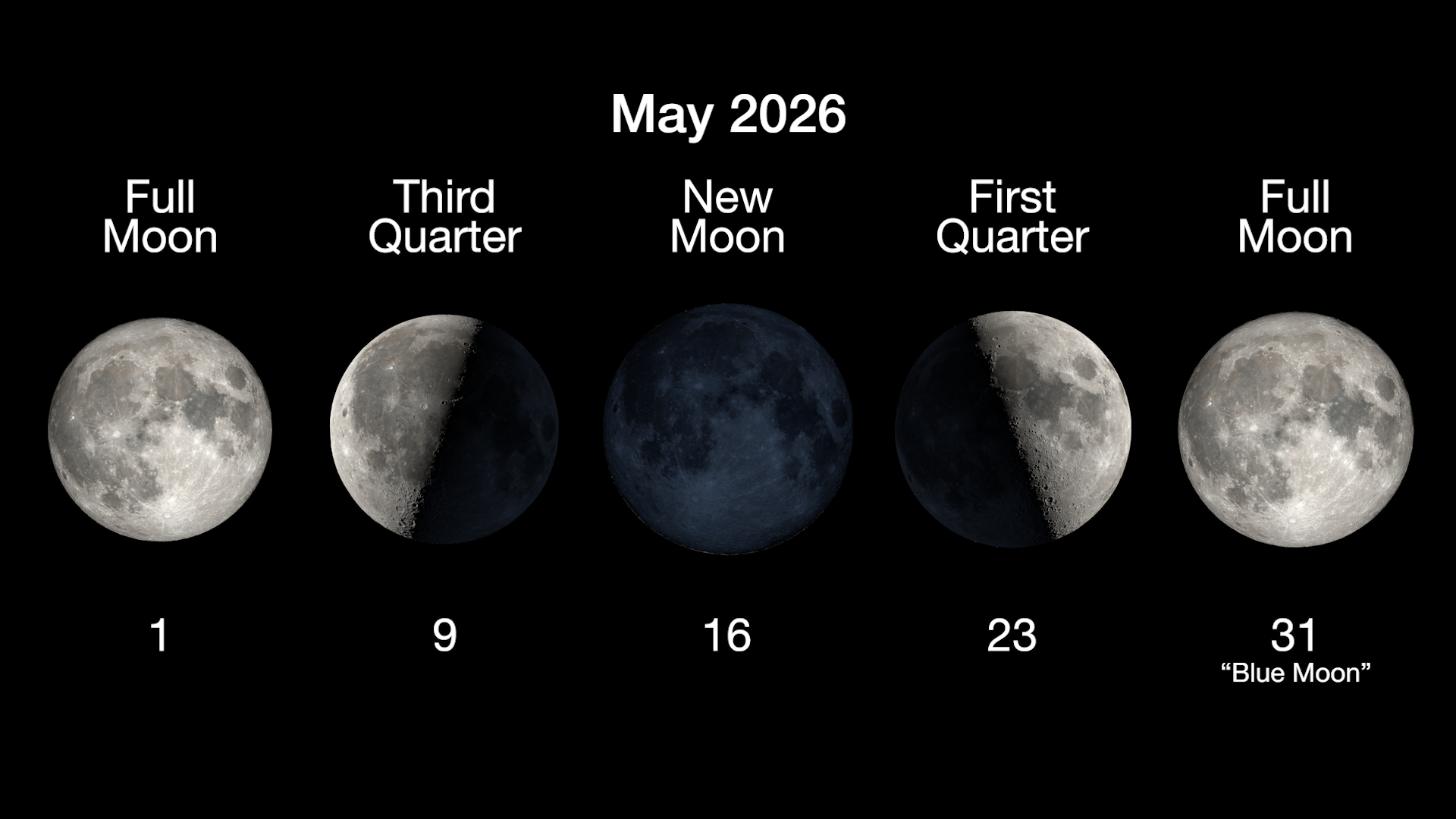
And now, May ends with another lunar moment: a Full Moon on May 31st. This one is a Blue Moon.
But it actually won't look blue.
Blue Moon is the name given to the second Full Moon in a single calendar month. It's a relatively rare event, hence the phrase "once in a blue moon."
So whether you're up before sunrise or out after sunset, May is a great time to look up.
Here are the phases of the Moon for May.
NASA/JPL-Caltech
You can stay up to date on all of NASA's missions exploring the solar system and beyond at science.nasa.gov.
I'm Raquel Villanueva from NASA's Jet Propulsion Laboratory, and that's What's Up for this month.